Your booking history can reveal which days fill first, what service types cause bottlenecks and where cancellations leave unused time. The aim is not to create the busiest-looking diary. It is to understand demand and match it to the way your salon actually works.
Useful analysis begins with clean appointment states and a few questions you can act on.
Decide what “busy” means
Tuesday shows ten bookings while Friday has five long de-sheds that use nearly all available working hours. A day with many small nail appointments is not necessarily busier or more profitable than one with fewer demanding full grooms.
Counting every calendar entry equally can produce misleading staffing and availability decisions. Compare occupied minutes, completed visits and service mix alongside booking counts before judging capacity.
Clean the booking states first
Separate requested, confirmed, completed, cancelled and missed appointment states consistently across your tools. Cancelled requests, provisional holds and no-shows should not appear as completed services unless the measure explicitly includes them.
A report counts thirty cancelled enquiries as visits and makes a quiet month look unusually productive. Poor data definitions can make a colourful dashboard less accurate than a simple manual tally.
Find patterns across comparable weeks
One public holiday, school event or unusually large customer may distort what appears to be a recurring pattern. Compare several weeks or months, note closures and exceptional periods and avoid drawing strong conclusions from tiny samples.
Correlation between weekday and booking volume is not proof that changing prices or hours will increase demand. A busy Saturday in one month reflects a local event rather than demand that repeats every week.
Look at lead time as well as volume
How early a slot fills can show demand pressure that raw appointment totals cannot reveal. A full diary may reflect a small total supply of appointments, not necessarily overwhelming demand.
Friday afternoons are booked weeks ahead, while Tuesday mornings fill only through short-notice requests. Track days between booking and visit by service and weekday, then consider whether capacity or waitlist rules should differ.
For instance, a Tuesday that fills only the evening before the appointment may suit short-notice booking offers, but the same weekday might be unsuitable for a long first-time service. Compare the requested services, total occupancy and actual travel or preparation before changing public availability. Keep a record of the explanation behind any adjustment so that later months can be compared fairly.
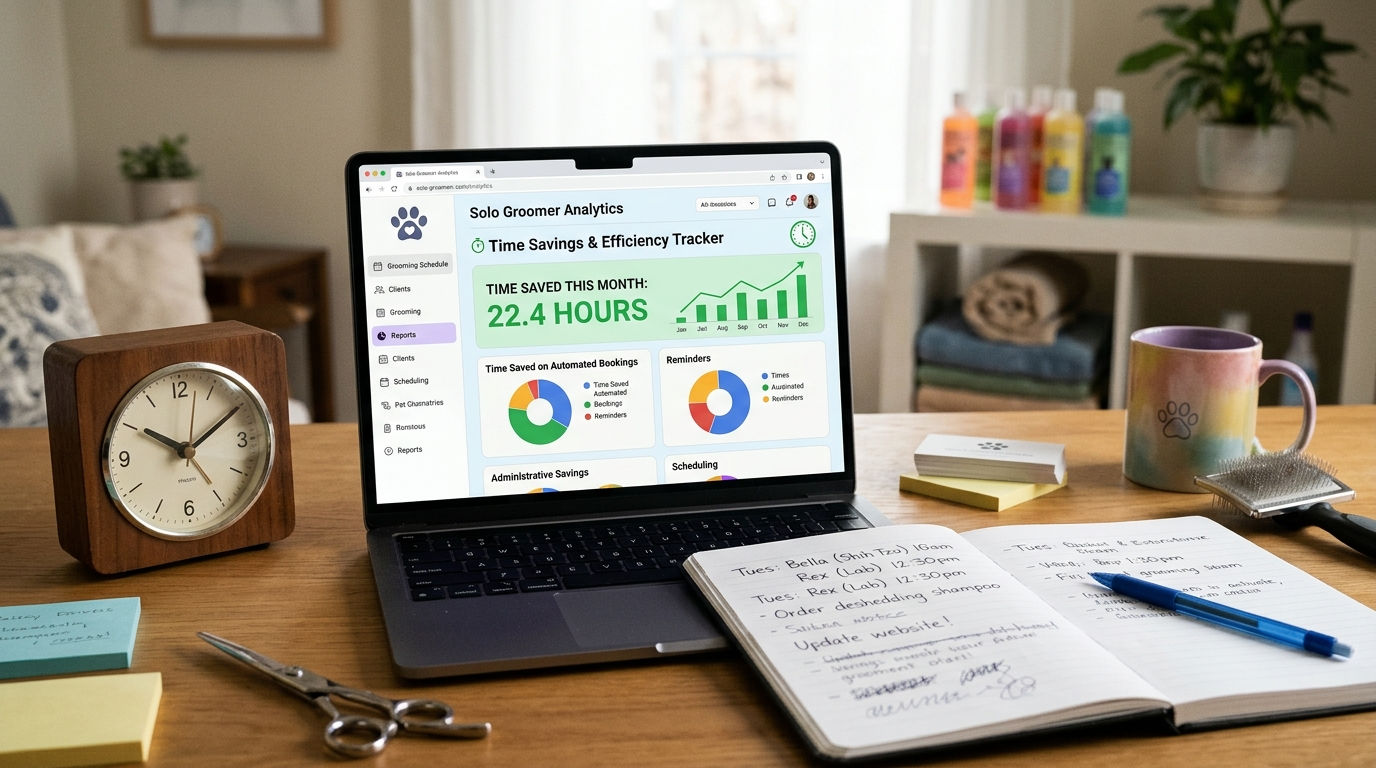
Time and occupancy should also be assessed against whether AI booking actually saves working hours.
Identify services that strain capacity
Some bookings consume more equipment time or create greater uncertainty than their quoted duration suggests. Large-dog drying delays the next service even when the recorded finish time technically fits the calendar.
Compare planned versus actual time for major service categories and note resource conflicts that repeat. Using the data to force faster handling can harm welfare; the aim is better estimates and sequencing.
Study cancellations and no-show gaps
Wednesday looks full every Sunday night but regularly develops two-hour gaps by Tuesday afternoon. A busy booking day may still yield little completed work if several appointments move or fail to attend.
Avoid assuming every cancellation reflects client carelessness; unclear policy or poor communications may contribute. Measure cancellations by notice period, service and day, then test targeted confirmation or waitlist improvements.
Turn observations into one small test
Choose one action, define what success would look like and review completed appointments and owner experience after a fair trial. Data becomes useful when it supports a controlled change rather than a general claim that something needs optimisation.
The salon notices a recurring quiet late-morning period and considers offering a different mix of suitable short services there. Changing pricing, hours and reminders simultaneously makes it harder to tell which adjustment mattered.
Protect privacy in reporting
Aggregate demand patterns rarely require staff to expose individual customer addresses or detailed pet behaviour histories. Use aggregated summaries for planning, limit access to identifiable records and delete unnecessary working exports.
A booking analytics feature should not turn operational customer details into broadly shared marketing material. A shareable chart includes names and phone numbers because it was exported directly from the raw booking list.
Ask a useful question before opening the dashboard
A colourful graph showing that Saturdays are popular may be unsurprising and not especially actionable. Decide what business decision you want the data to support: whether longer grooms are consistently under-allocated, which days have spare capacity, or whether short-notice changes cluster around particular times. Start with confirmed appointments and distinguish them from provisional enquiries, cancellations and completed visits. A calendar full of tentative holds can give a misleading picture of actual demand.
Look at the number and mix of services alongside the time they occupy. Four small appointments may take less working time than two complex long-coat grooms. If you measure only booking counts, you may misinterpret which day is genuinely busy. Include service duration, setup and cleaning where practical, and compare similar days over a reasonable period. A holiday week or one unusual large booking should not automatically determine a permanent change in opening hours.
Identify pressure points without overreacting
Review when appointments regularly finish later than planned. That pattern may suggest that a service duration is too short, a buffer belongs in the schedule or a particular sequence of services creates congestion. It could also reflect exceptional dogs that should remain individually assessed. A useful dataset includes enough context to avoid blaming the calendar for every delay. Simple notes such as “extra drying time” or “owner arrived late” can explain what a timing figure alone cannot.
For mobile grooming, add travel time to any assessment of productive capacity. A diary with several appointments spread across distant areas may look full but contain avoidable road time. Compare practical routes, not only the count of visits. If changing route order would reduce travel but inconvenience existing clients, weigh the customer impact rather than following an algorithm blindly.
Treat cancellations as a separate signal
An opening that appears after a cancellation is not the same as a slot that nobody wanted. Record when cancellations occur, whether they can be refilled and which service lengths match the available time. A waitlist may help with genuinely usable openings, but it cannot turn a twenty-minute gap into a two-hour grooming appointment. Look for patterns in rescheduling and notice periods before changing policy. Avoid assuming that every cancellation indicates a careless customer; the underlying reasons vary.
Use proportionate reporting. You usually do not need to expose client names, health details or full message histories to understand demand by weekday. Keep sensitive records separate from aggregate charts, restrict access and avoid exporting identifiable data into unrelated tools. A small salon can learn a great deal from a clear calendar and a basic spreadsheet without building a large tracking operation.
Turn insights into a controlled change
If the data suggests that Tuesday mornings are underused, experiment with an appropriate change rather than rewriting the entire schedule. If one service group takes longer than planned, adjust its duration and review the effect. Compare before and after periods fairly, taking account of seasonal demand. The point of booking data is not to produce ever more metrics. It is to support decisions that make the working week more realistic, the dog-handling experience calmer and the owner's time better protected.
A more revealing comparison than a busy-day chart
Take two days with the same number of bookings. One contains several short routine services; the other includes long coats, first visits and extended drying. The second may consume more staff time and equipment capacity even though the booking count is identical. Compare scheduled minutes with realistic service needs and note major reasons for overrun. That gives you a better basis for adjusting appointment lengths or buffers than a chart that ranks weekdays by the number of dogs alone.
Now look at an apparently quiet afternoon. Was demand genuinely low, or did a late cancellation leave a gap that could not be refilled? Would a waitlist have helped if the opening matched a suitable service? Keep these explanations close to the figures. A small amount of consistent context can prevent the salon from making sweeping changes based on incomplete data. Reports should support better decisions about work, not punish staff for encounters that required extra care.
Avoid overfitting a short period
A sudden rise in long-coat appointments or a holiday closure can change which weekday appears busiest. Before altering opening hours, check whether the pattern repeats across comparable weeks and whether demand involves services you can realistically accommodate. Ask what you would actually do differently with the information. A useful metric supports a decision; it need not be collected merely because a dashboard makes it easy to display.
Make a simple capacity report
- Compare visits by weekday and service type, not just total requests.
- Separate booked appointments from completed work, cancellations and no-shows.
- Use aggregated trends and avoid exporting identifiable customer details unnecessarily.
Official background reading for Using Booking Data to Spot Your Busiest Grooming Days
Ask the data a practical question
A useful booking report answers a question you are prepared to act on. Start with completed work, occupancy and lead time, then check the patterns against the lived experience of the salon. The goal is a more balanced week, not simply higher-looking numbers.