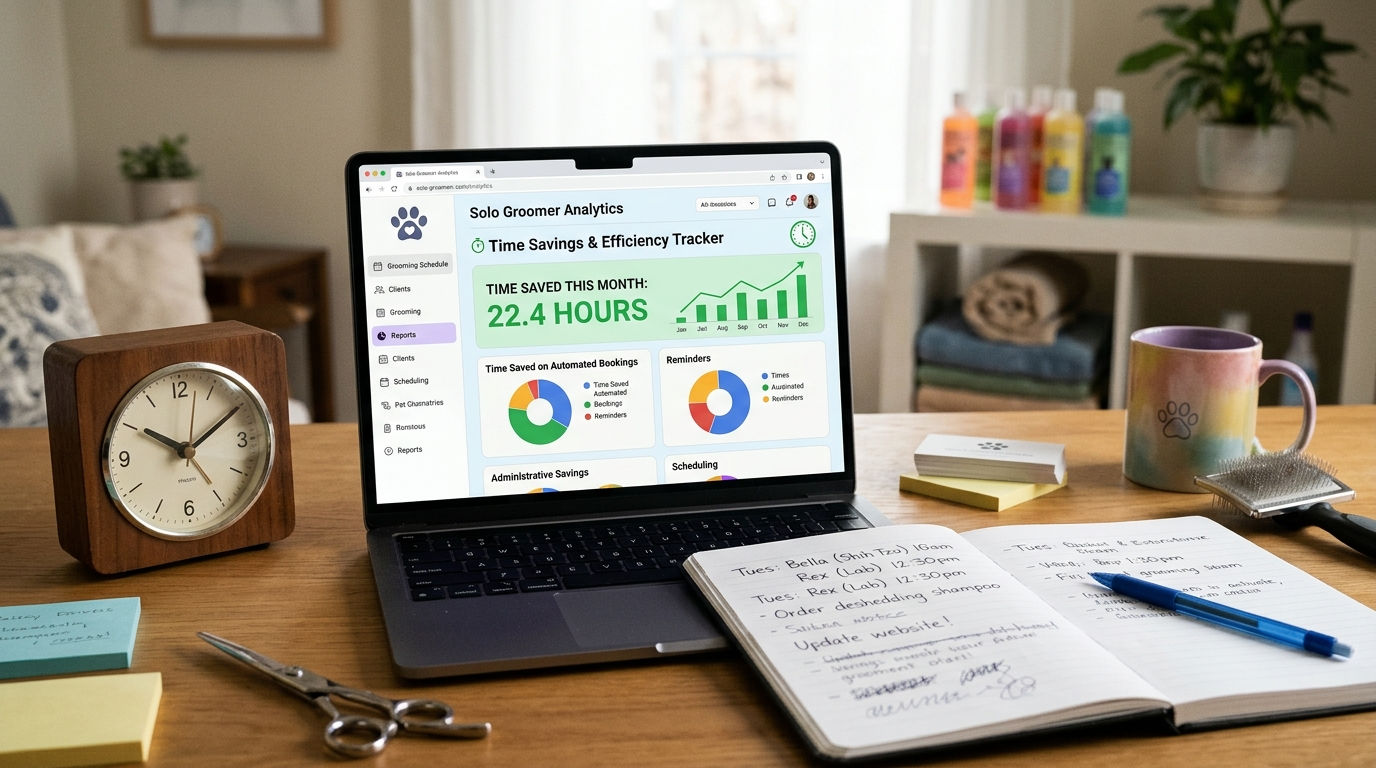
AI booking products often sound similar in a demonstration. They promise around-the-clock replies, fewer missed enquiries and smoother appointments. What matters for a small grooming business is whether the tool reliably performs the specific tasks that consume time today.
A useful comparison begins with your current workflow and proceeds through controlled tests, not a ranking built on marketing claims.
Decide what “AI booking” means in each product
Some tools answer FAQs, others capture enquiries and a smaller set can create live reservations with approved calendar connections. Ask the provider to demonstrate the exact journey from incoming request to final calendar record, including failure cases.
Do not compare a chat widget with a transactional booking system as if they perform the same job. A platform claims it “books automatically” but actually emails a lead that the groomer must call to confirm.
Prioritise salon-specific service rules
Dog size, coat condition, varying services and handling needs can complicate scheduling in ways generic appointment software does not recognise. A feature called “custom services” may still lack the resource and buffer controls that protect the working day.
A model offers a short grooming slot to a new long-coated dog because it has no information about assessment or drying time. Test whether the tool collects the right details, applies your service durations and allows human review for uncertain cases.
Check the quality of its handoffs
The assistant should know when a request is outside policy, uncertain or sensitive, and transfer context without making an unsupported promise. An owner mentions recent surgery and receives a confident approval for clipping because the bot is optimised to complete bookings.
Create test conversations that require escalation, then inspect the summary the groomer actually receives. If an AI tool rewards avoiding handoffs at all costs, it may hide important exceptions rather than handling them.
Examine connections to existing systems
An appointment is created in a separate AI dashboard but does not appear in the salon's booking calendar until later. A useful assistant should work with the calendar, payment and contact tools you already depend on or provide a credible migration path.
A logo on an integrations page is not evidence that the exact booking workflow is reliable. Ask about live reads and writes, duplicate prevention, sync delays, error handling and export options, and test them yourself.
Compare total cost rather than list price
Estimate realistic monthly enquiry volume and calculate per-completed-booking cost including manual corrections. Subscription tiers, message volume, voice minutes, onboarding, card processing and staff review can all change the actual monthly expense.
A low monthly voice-assistant fee becomes substantial after adding call minutes, SMS summaries and a premium calendar connector. “Unlimited AI” wording may still hide fair-use limits, paid integrations or expensive support plans.
Test privacy and supplier controls
Client conversations may include addresses, contact details and health-related pet information; AI services can introduce additional data processors. Review data processing terms, access roles, retention, exports, incident support and available controls over model use.
Do not treat a supplier's general security badge as a complete answer to where customer information goes. A provider retains every chat transcript indefinitely while the salon assumes the information disappears once a booking is made.
Measure experience on the customer's device
A booking flow should be quick and understandable on a normal phone, including for someone who dislikes talking to chatbots. A polished product demo on a large monitor can hide poor everyday usability.
A returning customer must answer nine questions before the assistant will offer a simple repeat bath appointment. Complete real test bookings, reschedules and corrections on mobile, checking for accessible labels and clear status updates.
Use a scorecard that reflects your priorities
Rather than crown one universal winner, assign more weight to the issues that most affect your small salon. A mobile operator may value route constraints and text updates while a fixed-location salon needs shared equipment scheduling.
Score reliability, calendar control, handoffs, privacy, price, ease of use and support after the same scripted test set. A single overall star rating cannot express whether a tool is suitable for your services and your tolerance for operational risk.
Once a shortlist is chosen, the next practical step is a staged AI booking rollout plan.
Compare real tasks rather than feature lists
A product page may promise chatbots, voice calls, instant booking and automatic follow-ups. Those features are not equally valuable to every salon, and the descriptions rarely reveal what happens when a dog needs professional assessment. Begin with a few tasks you actually want to improve: collecting after-hours enquiries, reducing interruptions, preventing double bookings or making reminders clearer. Ask each supplier to perform the same scenarios using your own service durations and booking rules. A side-by-side demonstration tells you far more than a table of ticks beside fashionable features.
Use an awkward booking request in the trial. For example, a first-time owner wants an appointment for two dogs, one with a matted coat, and asks for a fixed price. The tool should collect the relevant details and ask for human review rather than inventing a duration or promising a fee. Next, try two customers seeking the final Saturday slot. Does the system truly reserve the diary entry once, or merely produce convincing chat messages? The authority of the calendar connection is a more important distinction than how natural the assistant's voice sounds.
Examine the controls behind the interface
Ask who can change service descriptions, restrict available times, pause automated replies and approve exceptional appointments. A solo groomer should not need a developer every time opening hours or policies change. The control panel should make the difference between provisional requests and confirmed bookings obvious. Inspect how an assistant transfers a conversation to a person and whether staff can see what was already said. A tool that routes complex issues into an unmonitored inbox has not really solved the problem.
Data handling deserves the same practical scrutiny. Find out which providers process client and pet details, what they retain and how records can be exported or deleted. Look for sensible access controls and a straightforward route to correct errors. A vendor's security badges do not tell you whether the particular settings in your account are appropriate. If a feature needs unrestricted access to the entire customer database, ask why and whether narrower permissions are available.
Calculate cost under realistic use
A low advertised monthly price may exclude message charges, phone minutes, booking fees, extra staff, payment integration or essential support. Estimate an ordinary working month rather than the best possible scenario. Include the time the owner spends monitoring handoffs, correcting uncertain answers and maintaining service rules. If the tool saves a few repetitive messages but creates more questions about pricing or appointments, its benefit may be overstated. Some businesses value fewer interruptions even when direct revenue does not change; that is a valid outcome to assess without inflating it.
Check cancellation and exit terms before committing. Can you recover future appointments and client records in usable form? What happens if the AI service is unavailable for a day? Does the salon retain a workable calendar and a way to contact customers? A straightforward fallback is essential for a small business that cannot stop serving dogs because a software integration fails.
Make the purchase decision reversible
Trial one bounded workflow before moving the entire diary. Establish baseline measures such as time spent replying to enquiries, the number of corrections and client confusion. Review actual conversation samples and compare them with the previous method. A tool that passes a scripted sales demo but fails when an owner changes their request should not receive autonomous booking permissions. Expand only after the data, client experience and human handoff are dependable.
A small scoring sheet is enough
Give each candidate tool a score for the tasks that matter to your business: accuracy of the calendar, handling of complex grooming enquiries, ease of correcting mistakes, cost under realistic use, data portability and quality of human handoffs. Write a sentence beside each score explaining what you actually observed. For example, “Could not demonstrate simultaneous requests for the last slot” is more useful than “calendar integration: 3/5.” If the supplier will not let you test essential workflows, treat that as a limitation rather than filling the gap with promotional assumptions.
A decision should also reflect the person maintaining the system. A powerful integration that needs frequent technical help may be a poor fit for a solo groomer, while a simple calendar and text reminder service may cover most needs. Do not pay for voice AI or complicated reporting only because those features are included. Prefer a small trial that preserves a working manual fallback. If the provider cannot explain what happens when a connection fails, do not give the assistant authority to confirm appointments.
Score a shortlist using real salon tasks
- Ask each provider to demonstrate a reschedule, a two-dog booking and a human escalation.
- Check what happens when the integration or internet connection is unavailable.
- Compare the contract exit terms and ability to export client records as well as price.
Official background reading for Comparing AI Booking Tools for Independent Dog Groomers
Compare outcomes, not AI adjectives
The best AI booking tool for an independent groomer is not necessarily the most advanced. It is the one that reliably fits your current diary, reduces real work and lets you take over when judgement is required. Test complete booking outcomes, not just conversational fluency.