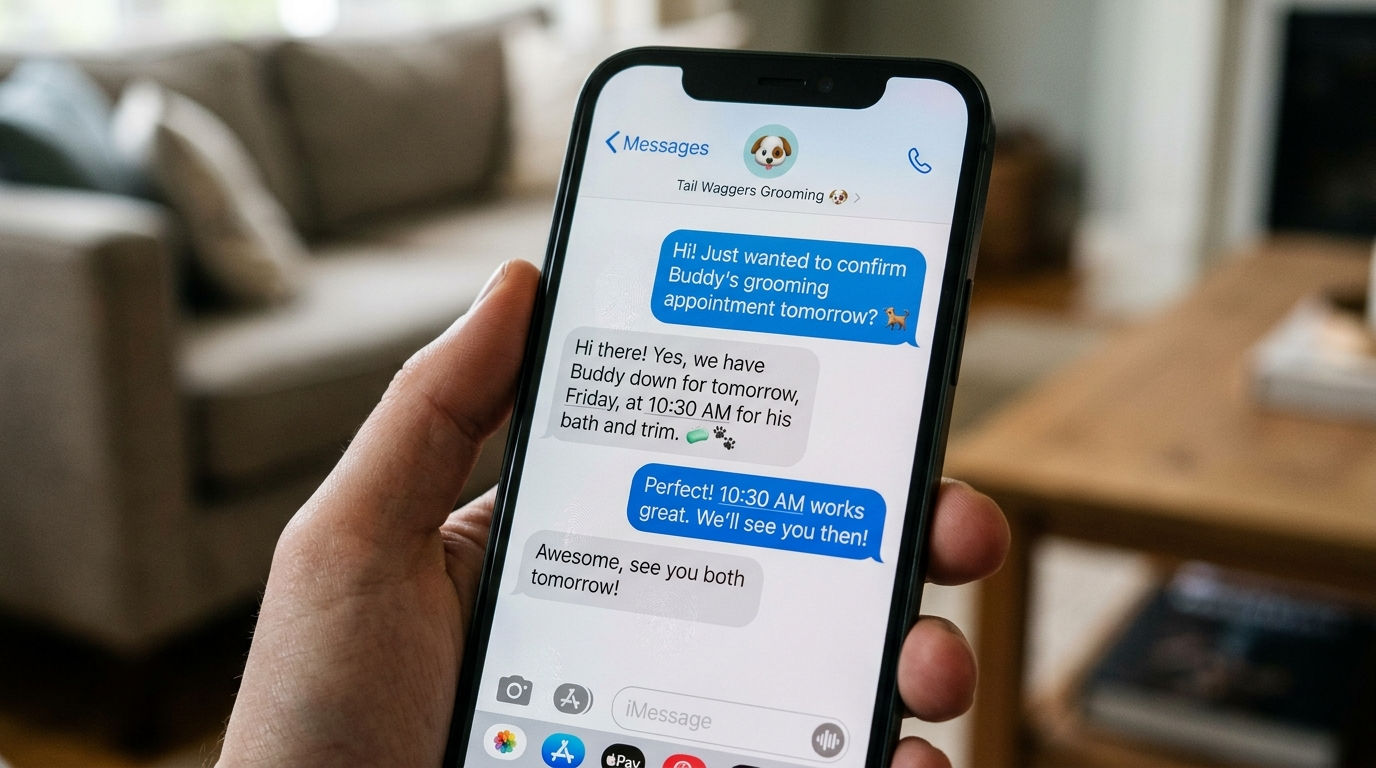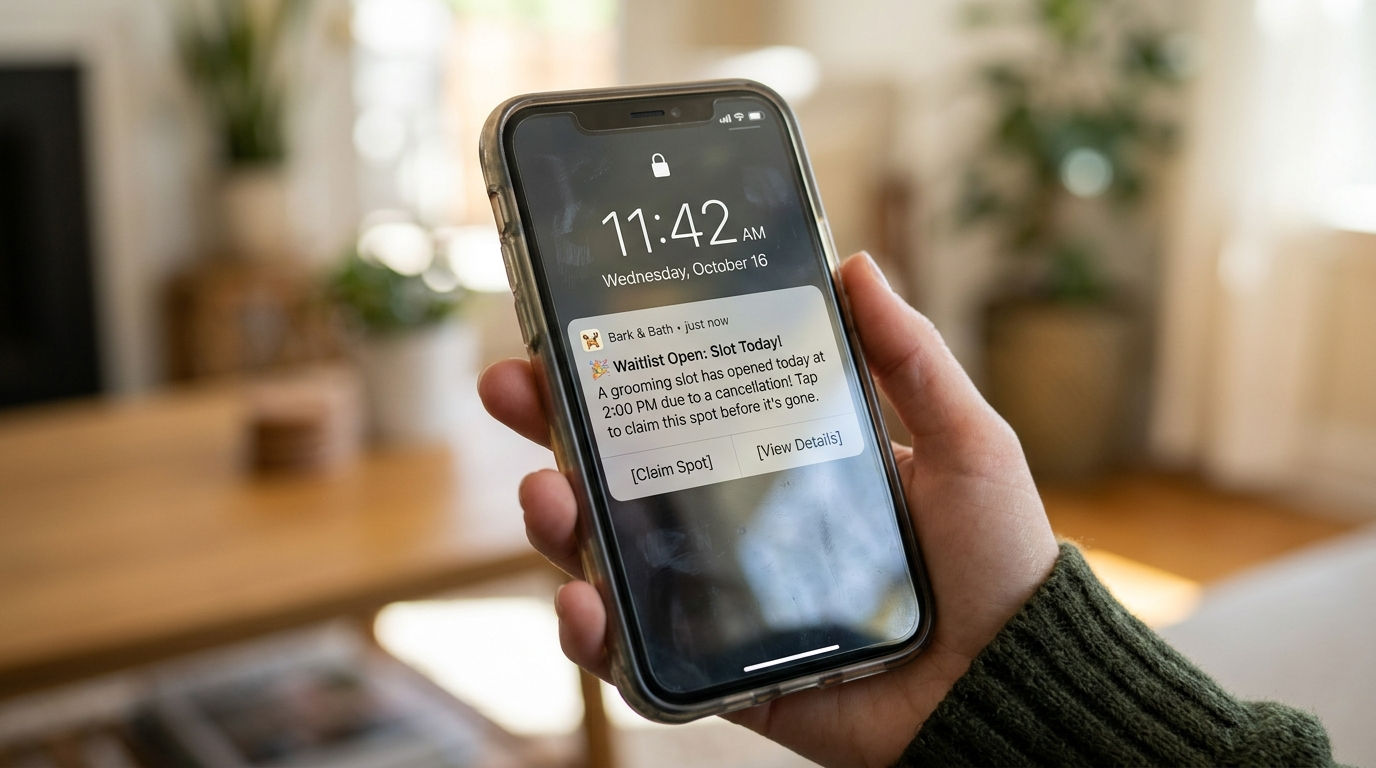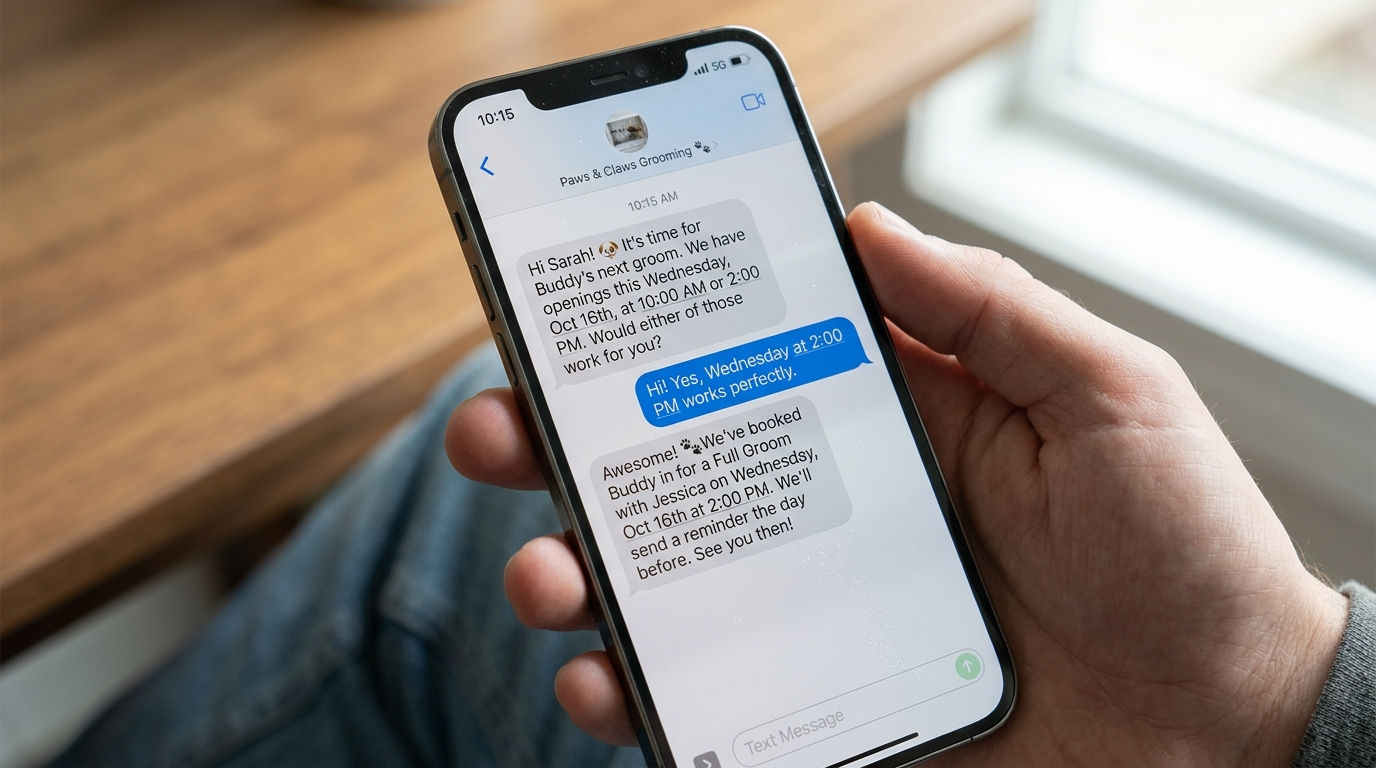
A one-way reminder tells the client what is scheduled. Two-way texting allows them to confirm, ask a question or report a problem without calling during salon hours. The feature is only useful if replies are actually understood, monitored and reflected in the booking system.
Treat a text response as information that may require action, not as an automatic instruction to rewrite the diary.
Make confirmation requests unambiguous
Include the dog, date and time in the message, and ask for a simple confirmation only when it serves a real operational purpose. Clients should know what “yes” means and which appointment it refers to, particularly when a household has several dogs.
A customer replies “yes” to an old reminder after a booking has already moved to a different date. An unexplained “reply 1” prompt can be confusing and may cause accidental responses from shared phones.
Separate confirmation from rescheduling
A client saying they cannot attend is not the same as accepting a new time; each action needs its own safe process. Use distinct reply states for confirmed, needs change, question and human review, with clear acknowledgement of what actually happened.
Never claim a newly proposed appointment is final before the calendar records it. An owner replies “Can't make Friday, maybe next week?” and the system marks Friday cancelled without offering or confirming an alternative.
Understand messy real replies
People use full sentences, spelling variations, emojis and messages that mention multiple appointments. AI may help interpret intent but can be mistaken. Automatic classification is not proof of consent or a safe basis for deleting a booking when context is unclear.
“Yes for Ruby, not for Max” arrives in response to a household reminder covering two dogs. Design follow-up questions for ambiguous replies and route complex cases to a person rather than guessing.
Keep inbound texts genuinely monitored
A client may assume any reply to a salon number reaches the business, even if the software only sends outbound messages. An owner reports that their dog is unwell but receives no response because incoming SMS is disabled.
Check that the supplier supports inbound delivery, display unread replies and assign responsibility for reviewing the queue. Do not invite replies to a number that silently drops them or receives them only in an account nobody checks.
Sync messages to current diary records
The client confirms on text after the groomer manually moved the slot, and the old appointment is accidentally restored. Two-way confirmations should reference one authoritative appointment and update its status without generating duplicates.
Texting tools that operate from a stale spreadsheet can create conflicts despite apparently simple workflows. Use reliable booking IDs, verify changes against current calendar state and show staff what action the reply caused.
For a consistent record across channels, revisit sending confirmations by text and email.
Make escalation feel natural
Acknowledge the concern, hold any unsupported decision and provide a clear human contact path without automatic medical advice. Questions about price, matting, welfare or a booking dispute need a respectful route to the groomer and an accurate response expectation.
A customer replies to a reminder that their dog has a painful patch and asks whether the visit should proceed. The system should not treat a sensitive free-text reply as a routine confirmation to maximise response rates.
Handle preferences and opt-outs carefully
Communication choices may differ for operational notices and marketing; a reply workflow needs to respect the distinction. Maintain relevant preferences, identify the business clearly and follow applicable messaging and data-protection requirements.
Sending marketing just because a client replied to a booking reminder is not a sound consent strategy. A customer asks to stop promotional texts but still needs an accessible way to receive appointment updates or contact the salon.
Test failure paths before relying on it
Try duplicate replies, incorrect numbers, delayed messages, expired links and customers responding after a slot is cancelled. The prettiest demo of “YES = confirmed” tells little about how reliably the process handles real people.
Two replies arrive minutes apart, one saying “yes” and one saying “change,” after the groomer already confirmed a new date. Record what the system does, identify which changes are reversible and verify that the customer receives an accurate final message.
A reply has to change the right record
Two-way text can save a surprising amount of back-and-forth, but only if the system knows which appointment a response concerns. A message saying “yes” might confirm tomorrow's slot, accept a new offer or answer a completely unrelated question. Use a clear request with the dog's name, date and an explicit action. If the response arrives after an offer expires, check current availability rather than treating the old offer as valid. Never let a free-text reply create a booking solely because it contains a positive word.
For a simple confirmation, define what “confirmed” means. It might mean that the customer intends to attend an already booked appointment, not that the software is creating a new reservation. Those states must remain distinct. If the owner replies “can't come,” the system should ask whether they want to reschedule or cancel, and apply the actual policy. A human may need to review the case where payment or a long service is involved.
Handle responses that do not fit the script
Clients will write in natural language: “probably,” “we're away until Friday,” “can you do both dogs?” or “Milo is nervous after his operation.” A rigid system can misclassify those messages if it expects only YES and NO. Build a route for unclear or sensitive replies to reach the groomer with the original text and relevant appointment details. Do not have the model decide whether a medical issue makes grooming appropriate. The assistant should recognise that the booking may need review and communicate that status accurately.
If a customer stops replying halfway through a change, keep the last confirmed appointment intact unless the agreed rules specify otherwise. A pending conversation should not silently free a slot or prevent the owner from seeing the real booking. Explain any expiry time on an offered alternative so a delayed reply does not create a dispute.
Choose a monitored number and a sensible window
A reply-capable SMS service creates an expectation that someone reads messages. Decide when the inbox is monitored and what the system says after hours. A solo groomer cannot always respond during bathing or clipping, so a realistic message such as “we'll review this during our next working period” is more trustworthy than “someone will reply in five minutes.” Avoid using a sender ID that clients cannot answer if your message invites a reply. Test a response from a real mobile phone, not only a dashboard preview.
Think about privacy and costs as well. Some providers charge per incoming or outgoing message, and sensitive details should not be repeated unnecessarily in a text thread. Keep a concise record of changes to the appointment while limiting access to the full conversation. A message sent to an old number should not expose extensive pet or owner information.
Resolve the conversation clearly
After a successful confirmation, cancellation or reschedule, send one concise message stating the actual result. If the diary could not complete the action, say that the request has been passed for review rather than implying success. Review conversations where clients ask “so is it booked?”; those are signs the closing message is not clear enough. The purpose of two-way texting is not to generate more exchanges. It is to reach a dependable shared understanding of the appointment.
A message sequence worth testing
Send a test reminder that says, “Milo's appointment is booked for Friday at 2 pm. Reply YES if you still plan to attend, or reply CHANGE if you need another time.” Then test the obvious replies and the less tidy ones: “yes but maybe late,” “can't come,” “can you do my other dog instead?” and a response received after the appointment has already been moved. The system must not treat all positive words as authorisation to make a new booking. A clear booking state and a safe route to a person matter more than an elaborate reply classifier.
Test how the message appears when a client uses a different phone, has no signal or replies after working hours. If the thread cannot be reliably associated with a known appointment, ask for clarification without revealing private details. When the outcome is settled, send one accurate closing message. A conversation that ends without stating whether the time remains booked is not a successful two-way confirmation, regardless of how quickly the automated reply arrived.
Treat ambiguity as a normal outcome
“I think so” and “yes, but later” are not clear authorisations for a calendar change. A system should preserve the existing booking, ask a short question or escalate the reply rather than guessing. Show the owner the final state only once the intended action has been completed. This is particularly important for appointments with deposits or multiple dogs, where acting on an ambiguous text could produce a financial disagreement or the wrong pet being expected.
Try messy confirmation replies
- Test replies such as “yes but 30 min late” and “can I bring my other dog?” rather than just YES/NO.
- Send ambiguous responses to a human before any booking details are changed.
- Check that the confirmation status shown in the diary matches what the client was told.
Official background reading for Using Two-Way Texting to Confirm Grooming Appointments
A reply is the beginning of a decision
Two-way texting is worthwhile when it closes the loop between messages and the diary. Make the expected reply clear, listen for ambiguity and provide a human route when the conversation stops being routine. A reliable answer beats an instant but wrong update.