Some grooming businesses have vaccination or health-document policies; others do not collect proof as part of routine booking. Before adding a vaccination upload field, decide what your actual salon policy requires and why that information is necessary.
This is an operational and data-handling question, not a substitute for veterinary advice. Rules and expectations may differ by business and local circumstances.
Define the purpose of requesting proof
A salon asks every returning owner to upload an entire veterinary history despite needing only confirmation of one specific policy requirement. Do not add document collection merely because a booking platform offers the feature. Tie every question to a real published business policy.
A generic “vaccines up to date” checkbox may not support the specific information the business says it needs. Write down what must be checked, at what stage and who is authorised to review it before building the form.
Explain the policy before the upload step
State the exact requirement in plain language at the point of booking and offer a route to ask questions. Customers should understand which evidence is requested and whether an appointment is provisional until the groomer reviews it.
An owner pays a deposit, then discovers after the fact that the salon expected a particular record before arrival. Never make assumptions about veterinary schedules, exemptions or medical suitability based on a platform's default setting.
Collect the minimum useful details
If documentation is genuinely required, avoid storing full records when a smaller verification note or limited field would meet the purpose. Consider recording what was checked, when and by whom, with only the limited evidence your policy and legal obligations justify.
More data creates more responsibility; do not retain complete images indefinitely simply because the system accepts attachments. A veterinary card includes addresses and unrelated treatment information that the salon does not need for booking.
Keep the booking state accurate
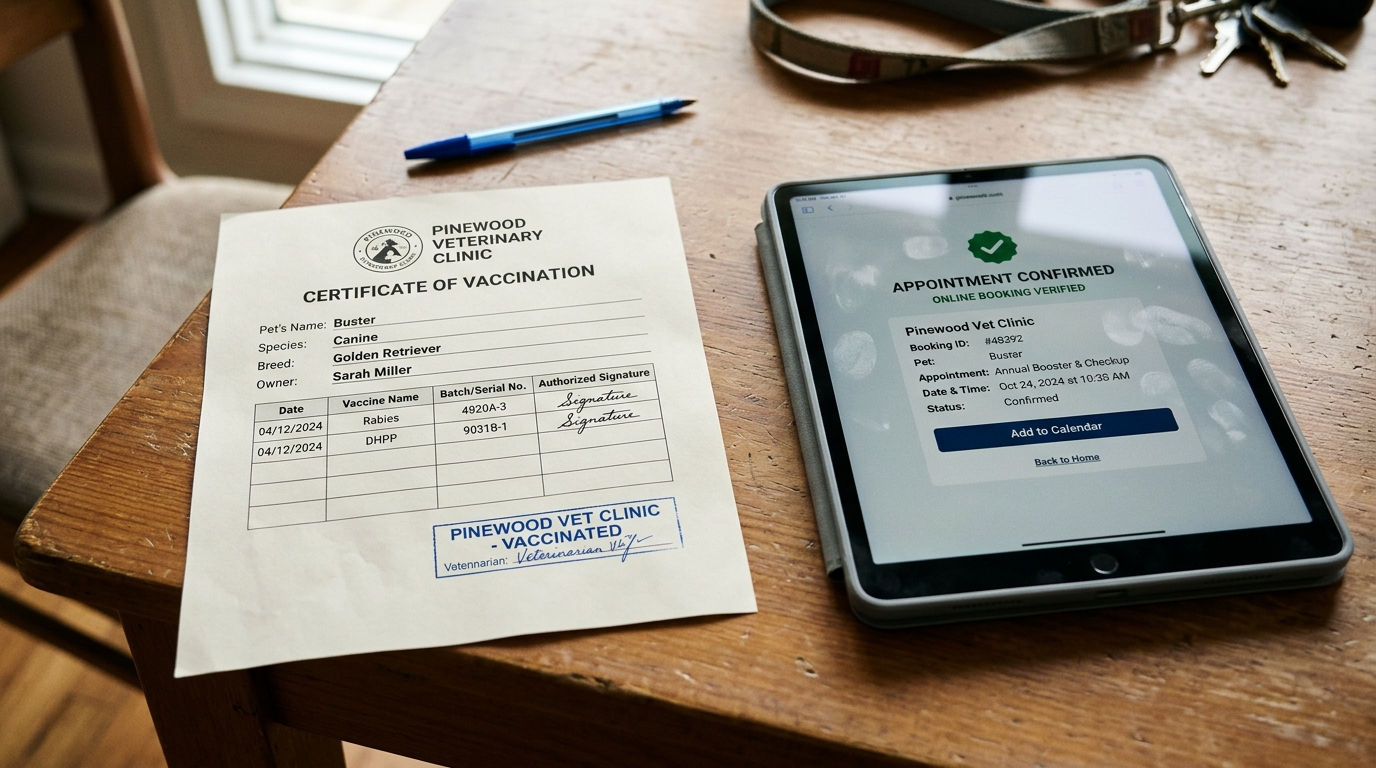
Uploading a document does not mean the content was reviewed or that the dog meets the business's policy. Automatic approval based on an unchecked filename or self-declaration is not equivalent to verification.
A customer selects a file and sees “appointment confirmed” before anyone has checked whether it is readable or relevant. Separate received, awaiting review, needs clarification and approved states, and communicate which stage affects the reservation.
Offer an alternative if uploads fail
Some clients have older phones, limited connectivity or records available only on paper. A fair process should not hinge on one device. A client cannot photograph their document clearly and repeatedly receives an error in the booking form.
Allow direct discussion or another appropriate way to present information, with a clear process for staff to update the record. A confusing technical barrier may cause cancellations while providing no meaningful improvement in the salon's information.
Protect access to uploaded records
A shared tablet is used at reception and exposes uploaded documents to staff who have no reason to view them. A document may contain personal details alongside animal information. Access controls and retention settings deserve attention.
Do not treat a cloud-provider logo or a password-protected account as a complete data-protection assessment. Check provider permissions, encryption claims, deletion options and how records are exported or removed at a customer's request.
Document collection should be reviewed alongside protecting client and pet data in AI booking systems.
Handle uncertain and exceptional cases manually
Do not offer medical interpretation through AI; direct the request to the groomer and, where appropriate, encourage discussion with a veterinary professional. Some records are ambiguous, unavailable or require a policy exception; these situations need a person who can explain the next step.
A dog has a documented veterinary exemption and the owner asks whether it changes the salon's requirement. An automated chatbot must not promise that a specific vaccine is necessary or sufficient without a valid basis.
Review whether the system remains proportionate
Policies change, booking tools change and the type of information collected can expand unnoticed. Audit form fields and stored records periodically, remove obsolete questions and confirm that the published policy matches actual practice.
Retaining information “just in case” is not a sound reason to keep collecting it without a clear purpose. Six months after launch, the system still requests a document nobody reviews and stores duplicate copies for repeat customers.
Start with the salon's actual requirements
There is no sound reason to collect a vaccination certificate simply because a booking system has an upload button. First establish which records the salon genuinely requires for its services, under its own policies and any applicable rules. Different activities and premises may have different requirements, and a grooming business should not present a blanket legal claim without checking it. If a record is necessary, explain what information is requested and why. A clear instruction helps owners understand the task without suggesting that the form is making a veterinary decision.
Ask for the minimum information necessary to apply the policy. In some workflows, an owner-confirmed status or relevant dates may be enough; in others, a document may be needed for verification. Those choices should be made by the business rather than by the software vendor's default field list. Where a document is accepted, restrict file types and size, tell clients how it will be used and prevent it from appearing in general booking notifications. The assistant should not draw veterinary conclusions from an image or substitute for professional advice.
Plan for missing or unclear documents
Owners may have a record on paper, a photograph that is partly unreadable or a certificate that is not in the expected format. Decide how they can correct the issue without losing their enquiry. A booking may need to remain provisional until the required information is checked; that state should be visible. Avoid automatically rejecting clients because an image-recognition tool cannot read a date or because the file has an unfamiliar layout. Human review is more dependable when the evidence is unclear.
If an owner says their vet has advised a different schedule, the grooming business should not attempt to resolve a medical disagreement through an AI chatbot. Explain the salon's booking policy and refer specific health questions to the appropriate professional. Avoid language that makes the system sound like it has certified the dog's medical fitness for grooming. The role of the intake workflow is to collect and route information, not to make clinical judgements.
Store only what the service needs
Documents can reveal more than the booking requires, including owners' addresses, clinic details or other personal information. Choose a platform with restricted access, clear retention controls and a way to delete outdated copies. If staff use email or screenshots as a temporary collection method, make sure those copies are not forgotten after the structured record is updated. Consider whether retaining the whole document is necessary once the relevant requirement has been verified. The privacy notice should describe the actual practice, not a future plan that has never been implemented.
Do not expose vaccination details in ordinary text reminders. A reminder can say that information is awaiting review or direct the owner to a secure route, without including private particulars. If two dogs share a household, keep their records separate. A certificate for one dog must not automatically satisfy a requirement for another.
Keep the record useful over time
Review expiry dates or recheck points only when relevant to the actual policy. Inform owners clearly if something must be updated before a later visit, and provide a straightforward method to do so. Make the system distinguish a genuinely verified item from an unreviewed upload. An orderly process prevents surprises at check-in and avoids making the groomer search a message thread while a dog and owner are waiting at reception.
Keep the request distinct from an approval
A certificate upload might be complete, partially legible or awaiting review. The interface should represent those states instead of treating any attached file as verified evidence. If the booking cannot proceed without a particular requirement, explain what must happen next and how the owner can ask a question. If the document is not necessary for the grooming service, do not collect it merely because the booking template makes the field easy to enable. The business should be able to articulate the reason for the requirement.
When staff check a document, they may only need to record the outcome and the date of review. Consider whether keeping the entire original file is justified under the salon's retention policy. A less expansive record can reduce the risk if an account is accessed incorrectly. The same principle applies to photographs and veterinary information: collect enough to operate responsibly, not as much as the software will allow. Keep any owner questions about medical implications outside automated eligibility claims.
Check that every recorded vaccination statement has a clear date and source, and distinguish information volunteered by an owner from documentation actually reviewed by the business. A booking form should not claim to medically verify the dog. When something is unclear, the grooming team can explain its policy and request clarification before proceeding.
Review the proof-request process
- Confirm which records the salon genuinely needs and why, before asking clients to upload documents.
- Provide a way for a staff member to review exceptions or unclear information privately.
- Set a documented retention period and avoid keeping unnecessary copies of veterinary paperwork.
Official background reading for Capturing Vaccination Details During Online Booking
Make document collection purposeful
Collect vaccination details only when the business has a legitimate, clearly explained reason to do so. Keep the questions narrow, the review human and the storage arrangements proportionate. An online form should help apply an existing policy, never invent one.