Booking forms can reveal important handling or coat concerns before the dog arrives. Their value lies in prompting the right discussion; they cannot diagnose a problem, assess a dog's welfare or determine whether a difficult groom should proceed.
The wording matters. A form that shames owners or forces blunt categories may produce incomplete answers at exactly the moment the groomer needs honesty.
Ask about experiences, not labels
A question about what the dog does in a specific situation is more informative than a single checkbox describing temperament. An owner might select “friendly” even though the dog has previously panicked during nail trimming and tried to escape.
Ask what happened during bathing, drying, brushing, nail handling or unfamiliar contact, and what seemed to help. Labels such as “bad dog” or “aggressive breed” can conceal context and create unfair assumptions.
Separate coat condition from appearance
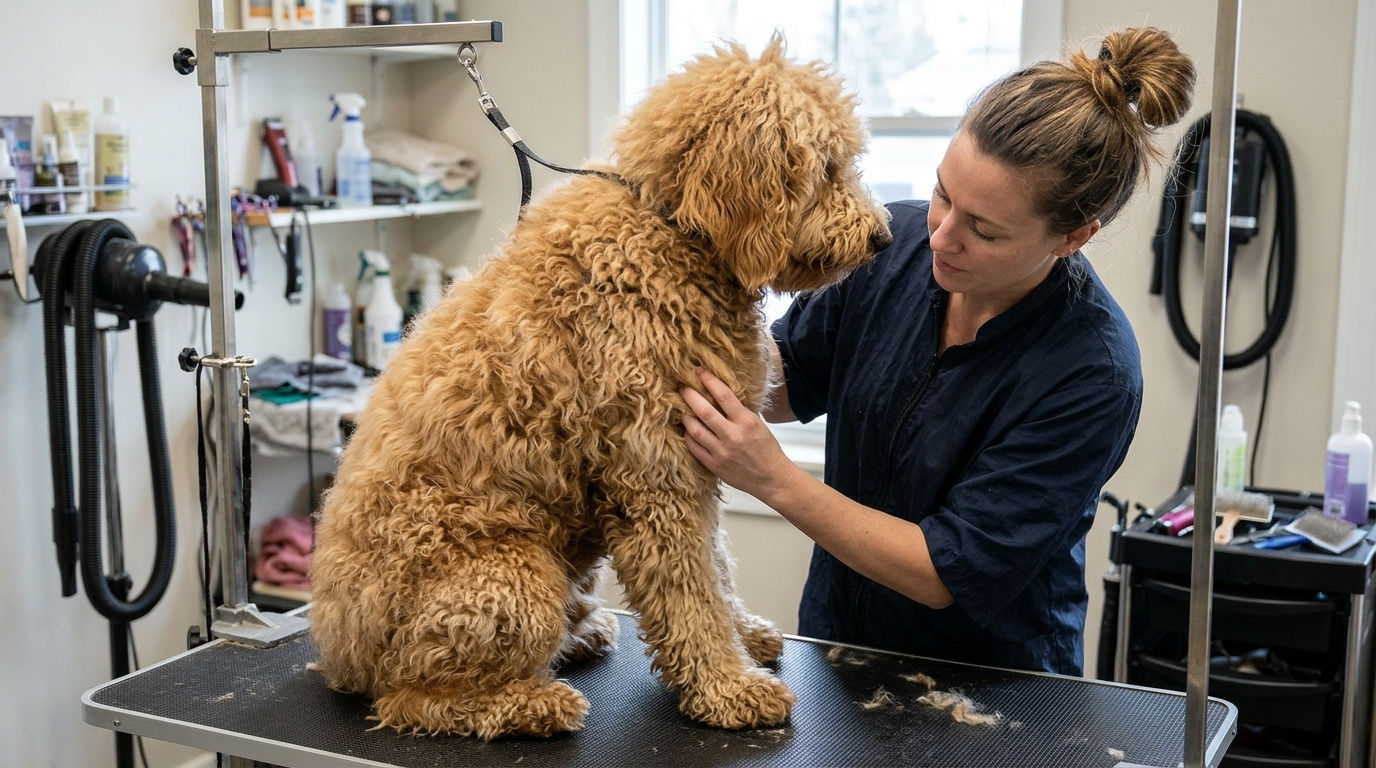
A long-haired dog has no visible tangles on its back, but the owner reports tight knots beneath the collar. Matting and compacted coat may not be obvious in a photograph or from a breed description; ask about likely trouble areas directly.
A form cannot reliably determine whether a coat can be brushed out or how long a safe appointment will take. Invite simple descriptions of brushing frequency, last groom, tangles and areas the dog resists having touched.
For kinder wording around coat concerns, read asking the right questions about matted or sensitive coats.
Give owners permission to be uncertain
Include options such as “not sure” and “please discuss,” and provide a small text box for essential context. People may not know technical terms or how a dog will react to unfamiliar salon equipment; forms should accept uncertainty without blame.
A first-time owner has never used a dryer on their puppy and cannot truthfully answer “tolerates high-velocity drying.” Requiring confident yes-or-no answers can turn missing knowledge into inaccurate booking data.
Trigger a genuine review, not a hidden score
Risk flags should initiate human contact or a modified booking process instead of silently rating the dog as suitable or unsuitable. Set visible escalation rules for severe matting, handling incidents, medical concerns and uncertain service duration.
Avoid using an opaque AI score to override the professional's own assessment or unfairly reject clients. A reported bite during previous nail work may require a discussion about services, expectations and whether the salon can safely help.
Connect flags to scheduling decisions
Information is useful only if it changes the plan where necessary, such as allowing extra time or arranging a quieter appointment. Automated systems should not assume that every flagged dog can be accommodated by adding an arbitrary fifteen minutes.
A dog sensitive to loud dryers may be better seen during a lower-traffic period if the groomer can accommodate that. Make flagged concerns visible before confirmation and allow staff to choose service duration or alternative arrangements.
Treat photographs as optional context
Pictures may help explain a concern, but they cannot reveal all undercoat, skin sensitivity or handling difficulties. An owner sends a close-up of a knot while the coat underneath and the dog's response to touch remain unknown.
Explain what photographs can and cannot help with, limit unnecessary metadata and discuss any uncertainty at the appointment. Do not use image analysis alone to assure the client that a coat treatment is safe or that a price is final.
Keep notes private and proportionate
A customer describes a stressful grooming incident and worries the information might appear publicly on a booking profile. Behaviour and health-adjacent observations deserve careful handling because they may be sensitive or embarrassing for an owner to share.
Collecting detailed incident narratives for every routine booking is excessive when a short handling flag is enough. Restrict access, choose sensible retention periods and make it possible to correct inaccurate notes.
Validate and improve question wording
Rephrase weak questions with concrete examples and compare whether the new answers actually improve booking decisions. Test the form with ordinary clients and look for answers that are consistently blank, misunderstood or too vague to help scheduling.
Many owners tick “coat condition good” while the groomer still has to call them about significant matting. Increasing form length is not automatically the solution; clearer, fewer questions can give better information.
Ask about experience, not labels
Owners may hesitate to describe their dog as aggressive, difficult or badly matted. A form that asks whether the pet is “problematic” encourages people to skip a useful disclosure. More specific, neutral questions work better: “Has your dog previously struggled with nail handling, dryers or being brushed around the face?” and “Are there any areas that become sore or uncomfortable during grooming?” Give owners room for a short explanation. The goal is not to categorise the animal. It is to let the groomer prepare an appropriate conversation and handling plan.
For coat condition, ask when the dog was last professionally groomed, whether brushing has become difficult and whether the owner has noticed tight tangles near the skin. Leave room for “not sure.” A photograph may help with preliminary planning, but lighting and surface appearance can conceal the severity of a mat. The form should not decide that a coat can be saved, a style can be guaranteed or a particular service will be comfortable. Those judgements belong to the professional assessment.
Make flags lead to a real decision
A warning that no one reads is just decoration. Decide which answers require an appointment to be reviewed before confirmation. For example, a reported bite during handling may require a conversation about the salon's ability to provide the service safely; a minor dislike of the dryer may be managed within an agreed plan. The software should make the distinction visible without automatically assigning a diagnosis or predicting behaviour. Where the form detects a concern, the response should say what happens next and avoid implying the dog is being rejected.
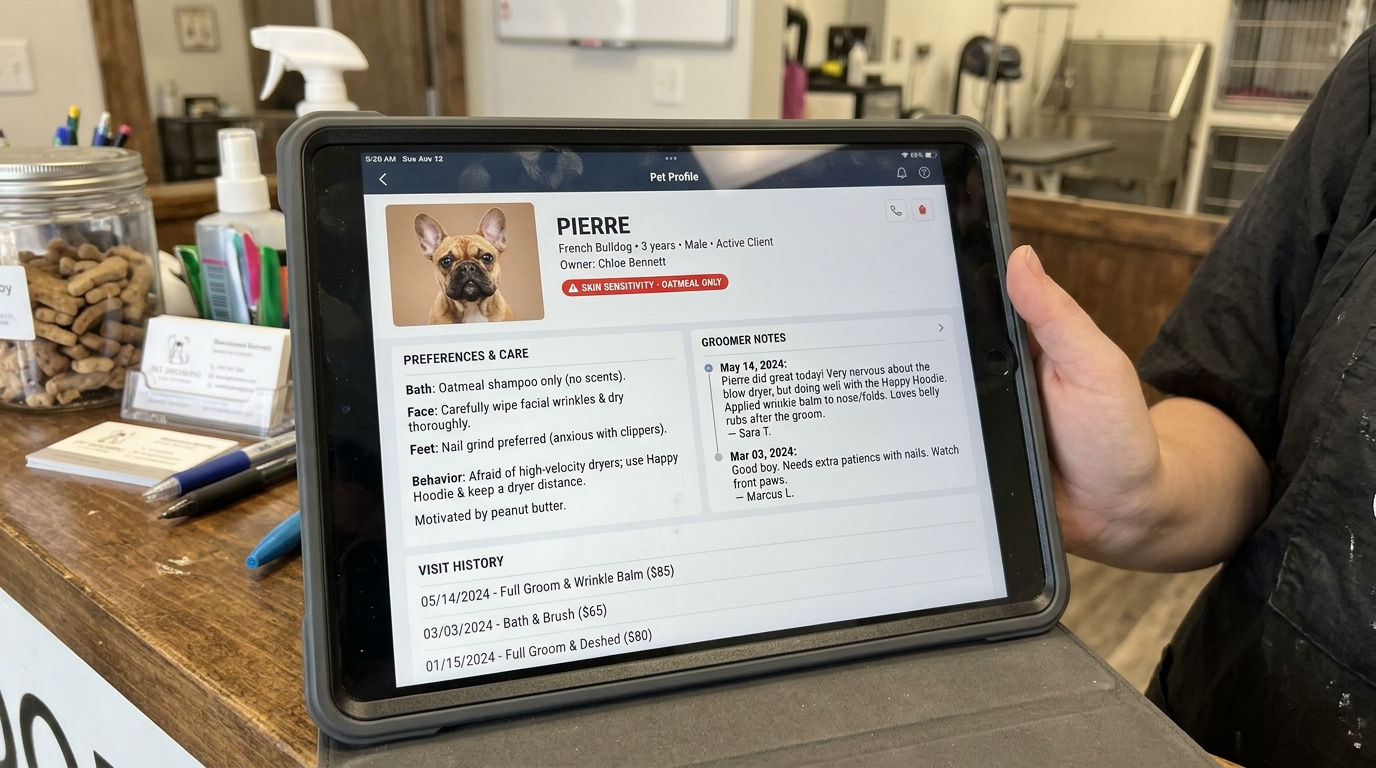
When several concerns are reported, present a concise summary instead of a pile of red icons. “Owner reports fear of nail handling, history of matting behind ears; assessment needed” gives the groomer something actionable. Preserve the owner's own wording where the detail matters. Do not let the system exaggerate a mild concern into a definitive risk category, and give staff a way to correct an inaccurate flag. Small inaccuracies can follow a pet through repeated visits if nobody owns the record.
Avoid making the intake an interrogation
Too many compulsory fields can deter the very clients whose dogs need extra discussion. Start with clear high-value questions and explain why they are asked. Offer an easy route to speak directly to the groomer, particularly when someone is unsure how to describe a recent change or a sensitive history. If the owner cannot provide a detail online, decide whether that truly prevents an enquiry or merely means the groomer should follow up. The form should help the client communicate, not become a barrier to humane service.
Use accessible labels, readable text and input types suited to phones. Radio buttons may be helpful for straightforward factual answers, while free text is better for nuanced situations. Avoid setting required values that encourage guesses. Test the form with clients who do not know grooming terminology. If they regularly misunderstand a question, change the wording rather than adding a longer explanation beneath it.
Review what the flags achieve
After a few weeks, ask whether the relevant information reached the groomer before the visit and whether the appointment length or handling plan changed appropriately. Identify flags that generate unnecessary follow-up and questions that fail to capture important details. Updating the form is an editorial decision as well as a technical one. It should remain proportionate to the salon's services and the needs of the dogs it handles, with human judgement guiding anything complex.
An example of a helpful flag
Suppose an owner writes, “She used to be fine with brushing but now pulls away when I touch her back legs.” The form should preserve that statement and mark it for the groomer's attention rather than assigning a behavioural diagnosis. A follow-up question could ask whether the owner would prefer a conversation before booking. The outcome may be an adjusted appointment, a consultation or advice to seek appropriate professional input for discomfort. An automatic reservation with no review would lose the very reason the question was asked.
The internal alert needs to be visible at the right moment. A tiny icon hidden in a client profile is easy to miss during a busy check-in. Put necessary information in the booking preparation view, using neutral language and a clear indication of who should review it. After the visit, the groomer can correct the note or record an updated observation. This prevents one uncertain client answer from permanently controlling future visits without context.
Keep the wording neutral so an owner can describe difficulties without feeling blamed. A form entry should alert the team to review the situation, not produce an automatic welfare or medical judgment. The groomer may still need a conversation, a different appointment length or a decision not to proceed safely.
Test the staff-review flag
- Submit a request describing previous distress and severe coat tangles without providing a diagnosis.
- Make sure the request remains pending until a suitably experienced groomer reviews it.
- Check that the client receives a respectful explanation and a safe next step, not an automated refusal without context.
Official background reading for Using Booking Forms to Flag Behaviour and Coat Risks
A flag is an invitation to ask
A good form creates earlier, calmer conversations about difficult issues. Focus on observable experiences, uncertainty and clear escalation. The groomer's judgement remains the deciding factor; the form is there to make that judgement better informed.