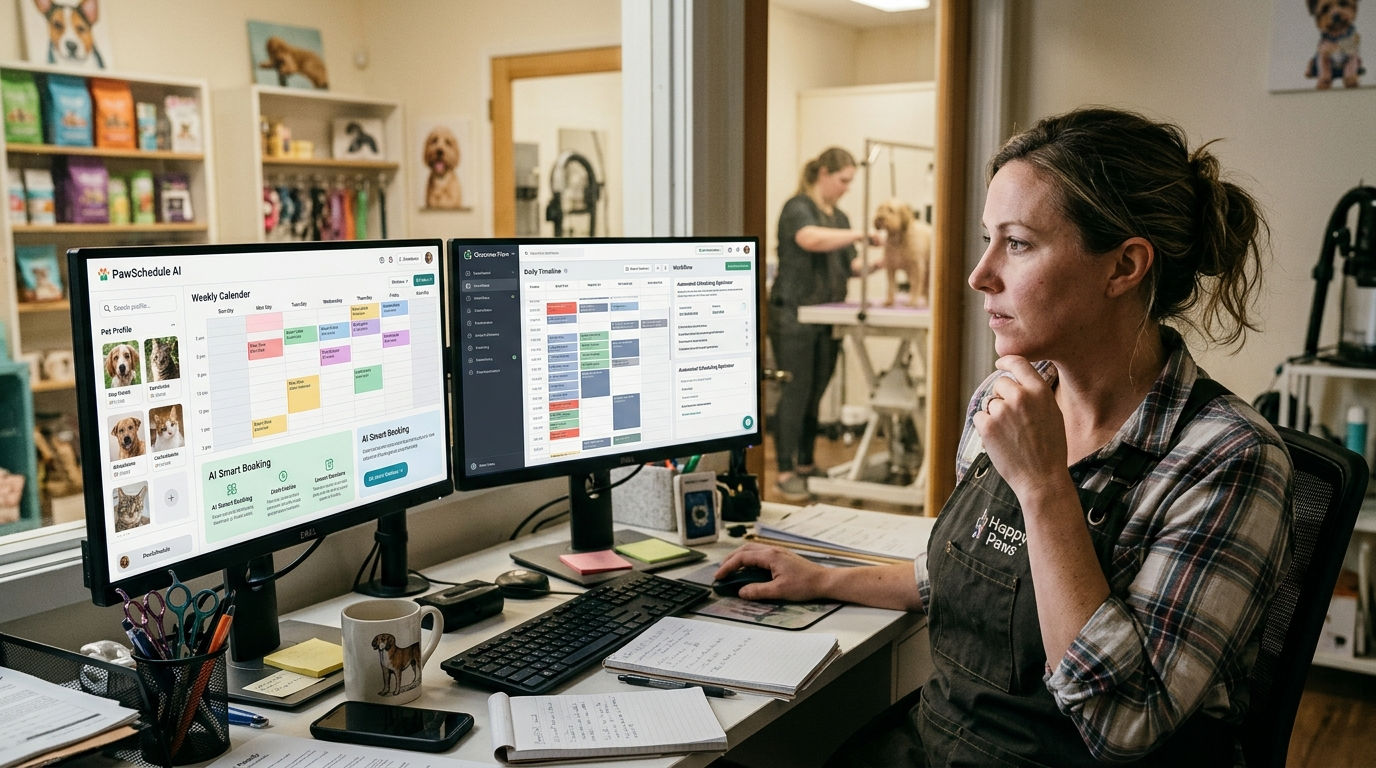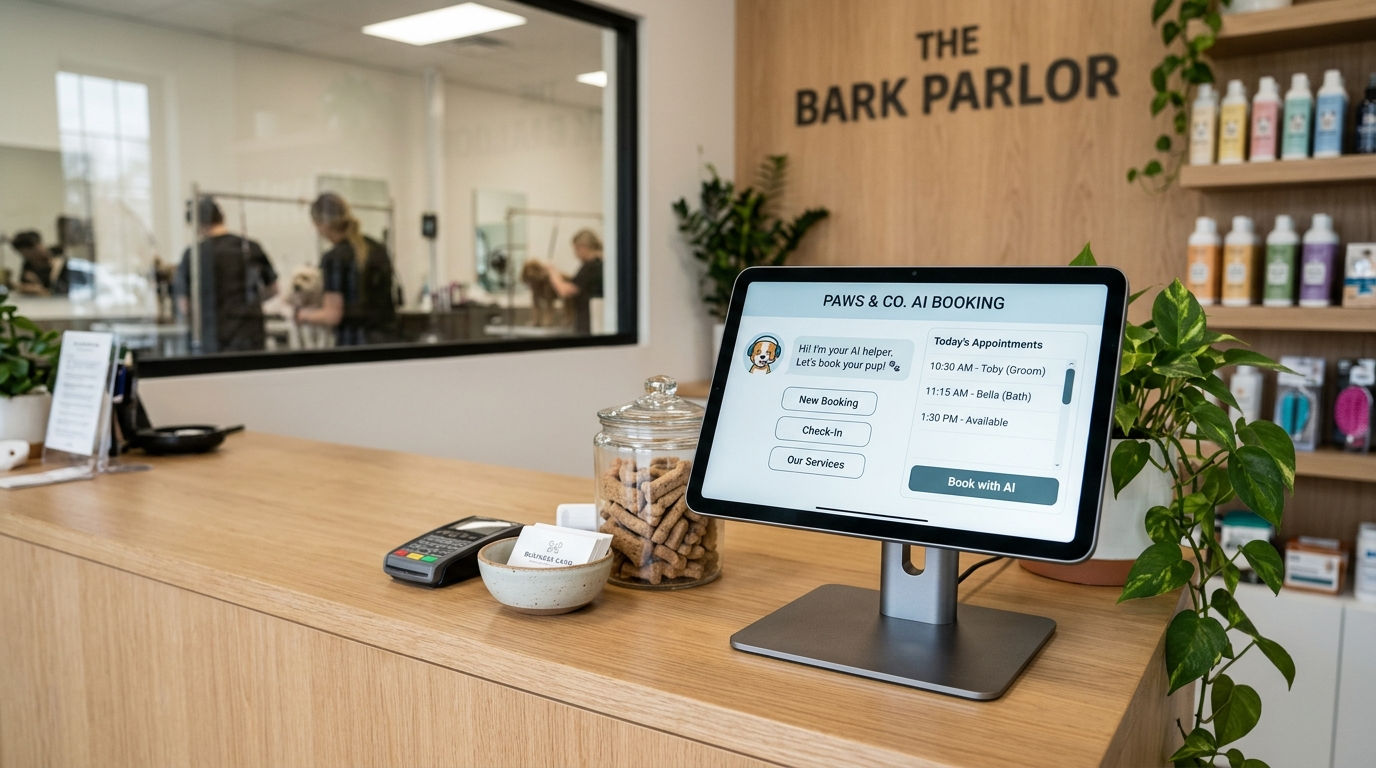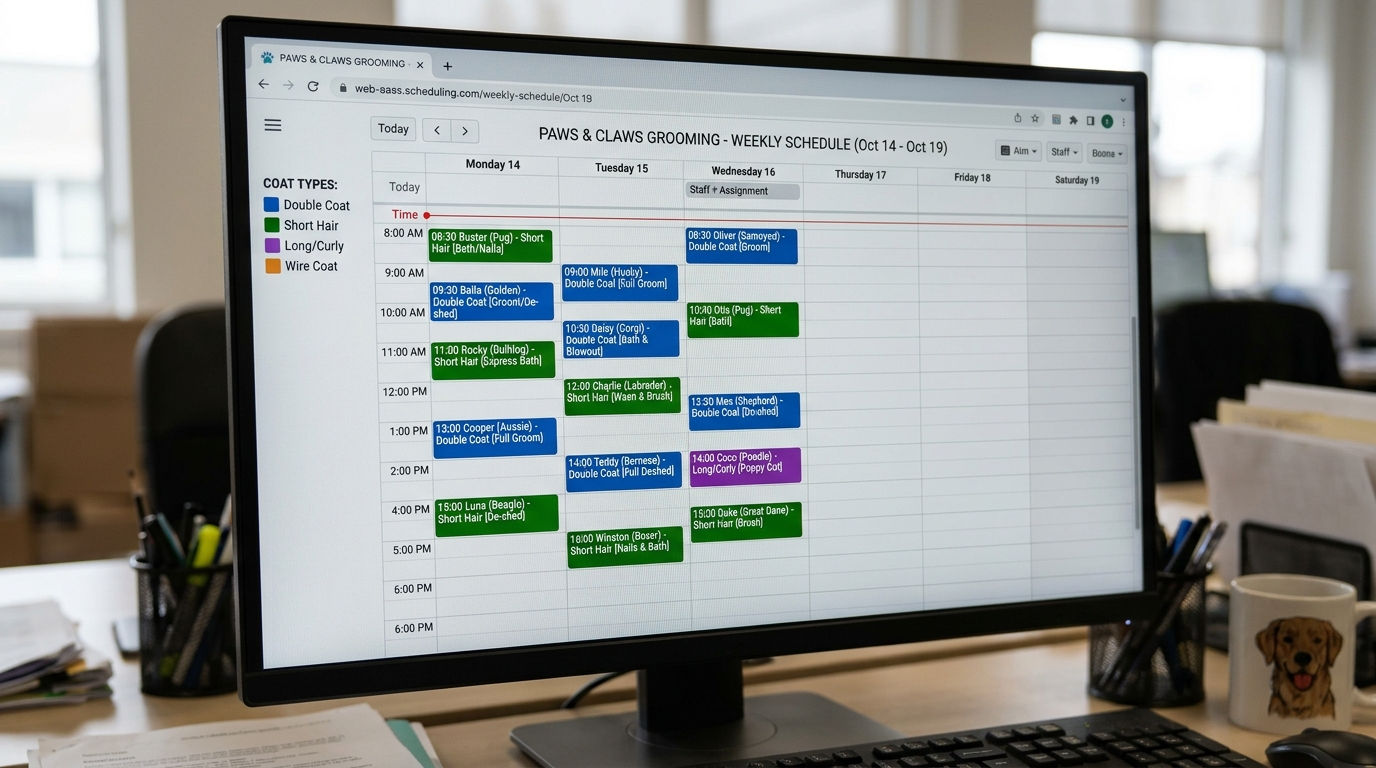
A grooming calendar should reflect the work on the table, not only the number of dogs you hope to see. A heavily coated dog, a nervous first visit and a simple wash rarely belong in identical appointment blocks.
Coat-aware scheduling does not require a complicated algorithm. It requires a few reliable service categories, the freedom to adapt them and a weekly routine for reviewing what has changed.
Separate the work into meaningful service groups
Start with services that genuinely differ in preparation, bathing, drying, clipping or hand-finishing instead of assigning one duration to every appointment. Review your past appointments and identify the small number of service types that account for most differences in chair time.
Coat descriptions from clients are useful clues, not guaranteed estimates of the work waiting under the fur. A double-coated dog needing a thorough dry may take longer than a short-haired wash despite a similar weight.
Estimate the full appointment, not just cutting time
Time includes arrival, assessment, handling, drying, cleaning and the client's collection, some of which cannot overlap safely. A timetable based only on hands-on clipping minutes makes every later appointment vulnerable to delay.
A trim that takes an hour of direct work may occupy the salon far longer once a cautious handover and thorough clean-up are included. Record start and finish times for a sample of visits, then create default blocks that reflect actual occupancy.
Place demanding coats where energy is available
The order of work affects concentration, equipment use and the chance of finishing on time. Choose a sequence that suits your environment. A large, densely coated dog may be better booked earlier, leaving the late afternoon for shorter appointments and collection calls.
Put known long or physically demanding grooms into deliberately protected blocks rather than allowing an online calendar to fill every remaining gap. Do not turn breed or coat type into an inflexible rule; individual assessment still matters.
Build honest buffers around uncertainty
One nervous dog needs several pauses, pushing the next booked appointment into the groomer's planned lunch break. First-time clients, matting and behaviour concerns are harder to time; a small unallocated margin can prevent stress spreading across the day.
Too little space risks unsafe rushing, but excessive blanket buffers can hide capacity that simpler services could use. Add appropriate buffers after high-variability services and consider human approval before those bookings are final.
The amount of protected time is explored further in setting booking buffers for longer grooms.
Consider shared rooms and equipment
Map the critical pieces of equipment and stagger services where the sequence would otherwise create a bottleneck. A calendar for staff members may still create conflicts if they depend on one bath, dryer or quiet handling area.
Two long-coated dogs require the high-velocity dryer at the same stage even though different groomers are nominally available. A staff calendar alone cannot guarantee that every physical resource is available at the right moment.
Keep returning dogs' notes current
Historical appointment time can be a useful starting point, but coats, age, maintenance and behaviour change between visits. Update pet profiles after the appointment with useful timing and handling observations; adjust future blocks when the pattern becomes clear.
Reusing last year's duration without checking can undermine even a carefully planned weekly calendar. A senior dog now needs longer breaks, while another customer's regular brushing has made their coat easier to maintain.
Review the week before clients arrive
A short advance review helps identify clusters of difficult grooms, unusual travel, staff absence and appointments awaiting clarification. A review that happens only after the first appointment overruns is too late to protect the rest of the schedule.
Three first-time appointments booked consecutively can create more uncertainty than the same number of established repeat visits. Mark questionable slots for contact, confirm missing service details and reserve contingency space where the week looks fragile.
Adapt without blaming the dog
When a planned duration proves wrong, look at the assumptions and information available rather than treating the pet as an inconvenience. A matting issue hidden beneath a coat may only become apparent when the groomer examines the dog.
Record the reason for the difference, agree any service change with the owner and use the learning to improve future bookings. Scheduling should support humane handling, never pressure a groomer to rush for the sake of an automated timetable.
Begin with a week of actual work, not idealised service lengths
Review recent appointments and separate the time spent on washing, drying, styling, setup, cleanup and client conversations. A short-coated dog that arrives brushed and relaxed may follow a predictable pattern; a densely coated dog that needs extensive drying may not. Instead of treating both as a generic “full groom,” create a few practical duration groups that reflect what the salon can deliver comfortably. Leave room for the unexpected rather than planning every minute of the day as if no towel, dryer or coat condition will ever cause delay.
Some services share resources even when two groomers are available. A single bath station or high-velocity dryer can become the bottleneck if appointments overlap without considering equipment. Map when each service needs those resources, not only when the dog arrives. In a one-person business, the constraint may simply be that you cannot safely handle two dogs at once. Scheduling software should enforce those limits or make them clear enough to maintain manually.
Decide where the demanding grooms belong
A heavy coat, first-time puppy or anxious dog may be easier to accommodate earlier in the day, when the groomer is less rushed and has more capacity to adjust. That is not a universal rule: some dogs do better at quieter times, and owners have genuine transport needs. Use what you know about each dog and your own routine. Avoid placing several uncertain-duration appointments consecutively without a way to absorb delays, particularly when the day's final collection time is fixed.
You can create a small number of appointment types for repeat clients with well-understood coats and keep a review path for less predictable bookings. A note such as “allow longer drying time” should affect the actual duration or buffer, not sit hidden in the pet profile while the calendar still allocates the usual short slot. When the coat changes significantly between visits, update the classification instead of assuming the previous duration remains accurate forever.
Account for the invisible work surrounding a groom
A calendar packed with hands-on services leaves no time to answer a complaint, clean equipment, wash towels, restock products or speak with an owner whose dog needs additional care. Some of these tasks can be scheduled as recurring blocks; others require a small flexible margin around appointments. Decide which are fixed and which can move. Protect a proper break as deliberately as a booked service, rather than hoping there will be an unexpected gap.
For mobile groomers, travel and setup are part of the appointment even when they are invisible to the client. A long journey across town may make an apparently free thirty-minute gap unusable. Cluster bookings sensibly by area when possible and account for traffic and parking uncertainty. If the software cannot calculate these elements, build them into your manual appointment rules before opening times to online customers.
Review the calendar using pressure points, not just occupancy
A fully booked week is not necessarily a well-designed week. Look at when late finishes occurred, which services regularly ran over, and where extra handling or cleaning was required. Compare similar appointment types rather than averaging every dog together. If one coat group is repeatedly underestimated, change its standard duration or require review for bookings that fall into it. If a long gap appears regularly, ask whether your service blocks are unnecessarily rigid. The aim is a week that remains workable when a dog needs more care than expected.
Try a colour-coded planning exercise
Before setting software rules, draw a normal week on paper. Mark firm commitments such as opening and collection windows, then place known longer grooms where you can realistically handle them. Use another mark for appointments needing coat or behaviour review. Leave visible space for cleaning, phone calls and breaks. This rough drawing often reveals conflicts that a calendar's default thirty-minute grid makes easy to overlook. It also shows where offering a short-notice opening would be genuinely useful rather than merely filling an empty-looking interval.
For each block, ask what could make the estimate wrong. A dense undercoat may need more drying, a first visit may take longer at handover, and a dog who dislikes handling may need pauses. Some uncertainty belongs in a wider service duration; some deserves a human review before booking. Keep these decisions simple enough to explain to an owner. A booking schedule should not depend on staff routinely finishing difficult grooms faster than is comfortable.
Rebuild one representative working week
- Group past visits by service and coat-work complexity rather than breed alone.
- Block cleaning, drying, breaks and unavoidable handovers before filling appointment slots.
- Compare the draft week against actual finish times and make room for the unpredictable visits.
Official background reading for Building a Weekly Grooming Calendar Around Coat Needs
Let the calendar serve the groom
A practical calendar accepts that grooming time has a range, not just a fixed value. Base the diary on observed work, distinguish variable appointments from predictable ones and preserve room for careful handling. The best schedule supports the dogs as well as the business.