Repeat visits make life easier for clients and groomers, especially when coats benefit from regular maintenance. But a recurring appointment is not an instruction to block an endless string of identical slots without review. Client availability, dog condition and salon capacity all change.
A good recurring workflow creates predictable opportunities and clear ways to adjust them.
Agree a sensible return rhythm
The interval between grooms depends on the dog, coat condition, service, home maintenance and the owner's preferences. An owner asks for an automatic six-week cycle, then reveals that the dog needs a different handling approach during seasonal coat changes.
Discuss an appropriate tentative interval with the client and record whether it is their preference or an agreed maintenance plan. A scheduling assistant should not prescribe a universal grooming frequency based only on breed name.
Decide how far ahead to reserve
An annual series of prime Saturday appointments remains blocked even after the client has stopped attending regularly. Booking many months automatically may give one family priority over everyone else and complicate staff leave or opening-hour changes.
An endless recurrence with no review point can turn convenience into hidden lost capacity. Establish a practical booking horizon and explain how future dates are confirmed, reviewed or released if circumstances change.
Keep the service matched to each visit
Check the service type at confirmation and allow the groomer to change duration before the appointment becomes final. A repeat customer may sometimes need a tidy rather than a full groom, or longer time after a difficult period of coat maintenance.
A winter visit is planned as a short maintenance trim while the spring appointment will need more extensive drying. Cloning the previous booking blindly can produce unsuitable prices, services and timing.
Make the calendar's recurrence rules clear
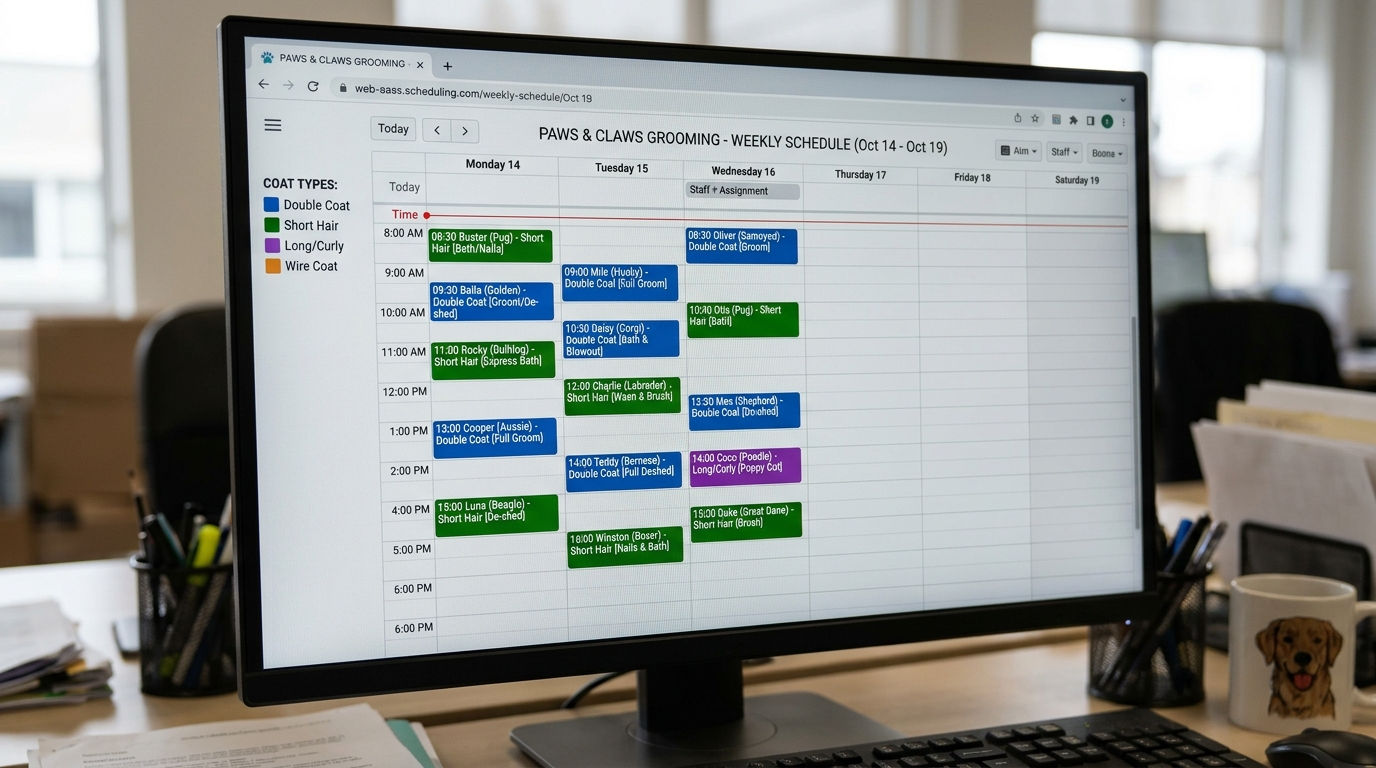
Software may support weekly, four-weekly or monthly patterns differently, and dates can behave unexpectedly around month ends and holidays. Test the chosen recurrence rules with real calendar examples and define what happens on a closure day.
Do not assume “every month” always means the same day-of-week or the same number of weeks. A recurring visit set for the last Friday of the month shifts when the salon closes for a public holiday.
Provide easy confirmation and changes
Clients should know whether a future slot is definitely reserved or only suggested, and how to correct a clash without awkward conversations. Allowing unrestricted last-minute moves can undermine a carefully planned grooming week.
A family accepts the next appointment at collection, then discovers a school commitment two weeks later. Send a clear future-date summary and a dependable rescheduling route that keeps the groomer's buffer and service rules intact.
For a repeat-booking series, show the client the next two actual dates instead of only the general interval. This reveals holiday shifts and calendar changes early, when both sides can still adjust comfortably. When the salon changes opening hours or staff availability, review affected recurring bookings before releasing new online slots. Each promised appointment should be visible in the same diary used for ordinary bookings.
When a repeating appointment must move, the boundaries in client self-service rescheduling become especially useful.
Avoid duplicate series and stray bookings
A repeat schedule can collide with a manually created appointment or survive after a customer moves to another groomer. A client books their regular visit online without noticing that the salon's recurring system already created one.
Search for existing future appointments for the same dog before making another booking, and review inactive series periodically. Cancelling one occurrence must not inadvertently erase the entire series unless the client intends that.
Monitor attendance without over-messaging
A client with six booked visits receives weekly prompts to “book now” even though the diary is already full for their dog. Regular visits do not require repetitive sales pushes; clear operational reminders and respectful rebooking suggestions are usually enough.
Sending more reminders than necessary can make a thoughtful recurring service feel intrusive. Suppress irrelevant campaigns for clients with confirmed future bookings and distinguish appointment messages from optional marketing.
Review what repeat scheduling actually saves
Compare completed recurring visits, adjustments and unused reservations with the equivalent manual process. Regulars can stabilise a diary, but the benefit depends on attendance, appropriate duration and how much time the system takes to manage.
A recurring calendar looks full while late changes leave several difficult-to-fill gaps every month. A fixed schedule is not automatically profitable if it ties up valuable time or limits the services you can reasonably accept.
Recurrence is a preference, not a permanent guarantee
Many owners like a steady rhythm for grooming, especially when coat care depends on regular maintenance. But a request to repeat every six weeks does not guarantee the same day, time or appointment length indefinitely. Holidays, the groomer's leave, the dog's changing coat and the client's own routine can all interrupt the pattern. A good system makes the future appointments visible and confirms each one under the actual salon rules, rather than quietly generating a year of assumed availability.
Separate the repeat interval from the service duration. A dog returning after a long gap may need more time than one seen regularly. If the owner misses a session, do not automatically move the next appointment into a short slot simply because the recurrence rule still exists. Provide a way to flag changed coat condition, behaviour or health information and request a revised appointment length. The groomer's judgement should override the repeating pattern when the work no longer fits.
Choose a scheduling method that staff can understand
Some salons pre-book a small series of confirmed appointments, while others send an invitation to book again at a suggested interval. The first approach provides diary certainty but creates more future changes; the second is flexible but depends on client action. Consider a hybrid for your regulars: offer the next appointment at collection and schedule a reminder to book later in the cycle. Decide what happens if the client ignores the invitation or wants a different service, and avoid describing a suggestion as an established reservation.
If your software supports a recurring series, test edits carefully. Changing one appointment should not silently shift every visit, and cancelling an individual date should not delete the entire arrangement unless the owner chooses that outcome. Make the choice visible with wording such as “this appointment” versus “all future appointments.” Confirm each action with the actual dates affected. Clients and groomers need to understand the difference between a repeating preference and the live calendar entries it produces.
Manage holidays and diary exceptions deliberately
Bank holidays, training days and seasonal peaks create awkward conflicts in repeating series. Review future appointments when annual leave is added, not only when the first collision is near. The system should identify which clients are affected, offer suitable alternatives and avoid moving a large dog into a slot reserved for a small service. If changing the appointment alters the interval, discuss whether subsequent visits should follow the original cycle or the new date.
For repeat clients with multiple dogs, confirm whether each animal still requires the same service and time allocation. It is tempting to copy last visit's notes indefinitely. Better practice is a brief update at each booking or confirmation, particularly for dogs whose comfort, mobility or coat condition can change. Saving regular details reduces typing; it must not remove the chance to correct them.
Measure whether the pattern is helping
Look at the percentage of future slots that are actually kept, how frequently clients move them and whether the service duration remains suitable. If a particular recurrence interval leads to constant rescheduling, it may be more practical to send timely booking invitations. Keep the process personal: a well-placed conversation at collection can reveal changes that an automated schedule would otherwise miss. Recurring booking should make planning calmer, not create a diary full of distant appointments that nobody has genuinely confirmed.
One missed visit can change the whole plan
Consider a dog usually booked every six weeks whose owner skips an appointment while travelling. The next visit might now be twelve weeks after the last groom, which could change coat condition and the time required. The system should not blindly offer the original short service. Ask whether the coat or the dog's circumstances have changed, and allow the groomer to adjust the appointment. Also clarify whether the customer wants future dates to follow the original cycle or restart from the eventual visit.
This matters especially when a repeating series contains a deposit or special time slot. The owner should be able to see which appointments are actually confirmed, and a single cancellation must not create confusing future charges. Regularity is useful because it supports preparation, not because it removes the need for fresh information. A predictable schedule still needs occasional human review.
Check the next three recurring appointments
- Verify that calendar recurrence respects closures, annual leave and public-holiday exceptions.
- Adjust one visit without silently moving every future appointment.
- Ask the owner to confirm changes in coat condition or service needs rather than repeating outdated notes forever.
Official background reading for Managing Recurring Dog Grooming Appointments Online
Recurring should mean helpful, not permanent
Recurring bookings should create predictability without becoming rigid. Agree a return pattern, confirm individual services and make changing plans simple. A little planned review protects both long-term client relationships and a healthy appointment diary.